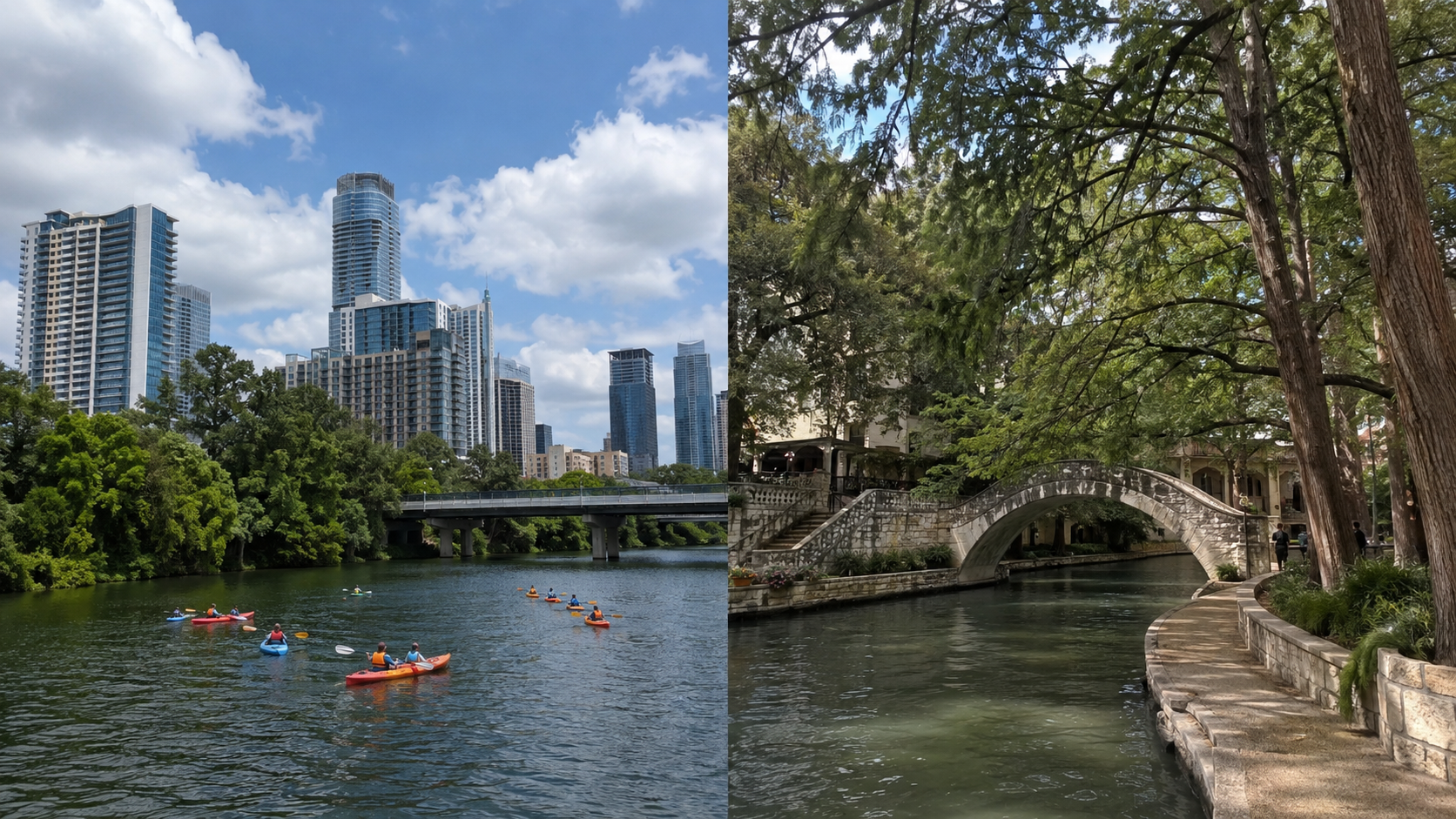
Introduction: the direct answer
Choose San Antonio for a more compact first-time route centered on history, the river, and an unhurried pace. Choose Houston for a bigger museum-and-food trip with more variety and more demanding transportation.
San Antonio is easier to organize around a compact historic core, especially for a first visit. Houston trades that simplicity for a much broader choice of museums, cuisines, and neighborhoods. The better weekend depends on whether you value a clear central route or metropolitan variety.
This guide compares the two without promising live prices, operating hours, weather, or availability. Use it to narrow the decision, then verify the details that could change the trip directly with transportation operators, attractions, lodging providers, and official weather or safety sources.
Table of contents
Quick comparison
| Decision factor |
San Antonio |
Houston |
| Defining experience |
Spanish colonial history, river-level walks, established visitor sights, and a slower central-city rhythm |
Major museums, globally varied food, parks, performing arts, and metropolitan scale |
| Transportation reality |
A downtown and River Walk itinerary can be car-light; the missions and outer neighborhoods need a deliberate excursion plan. |
Central clusters can work with rail and rides, while widely separated priorities make driving useful. |
| Food character |
Tex-Mex, Mexican American traditions, bakeries, markets, and contemporary restaurants all contribute to the visit. |
A far-reaching mix of regional and international cuisines is a primary attraction, though the best plan stays geographically focused. |
| Attraction pattern |
The Alamo and other historic sites, the River Walk, museums, markets, and the San Antonio Missions corridor. |
Museum District institutions, major parks, food districts, performing arts, and Space Center Houston beyond the core. |
| Best planning style |
Choose a compact base and protect time for the leading interest |
Organize each day geographically and price transfers before booking |
| Main tradeoff |
A popular date or scattered priorities can make a seemingly simple trip expensive |
Greater breadth can create longer distances, decision fatigue, or a need for a car |
The table is a starting point, not a verdict. The most useful row is the one tied to the reason you are traveling. If food is the purpose, compare the restaurants or neighborhoods you would actually prioritize and the route between them. If rest is the purpose, weight lodging location, noise, and daily transfers more heavily than attraction count.
How the experiences differ
The case for San Antonio
San Antonio works best when Spanish colonial history, river-level walks, established visitor sights, and a slower central-city rhythm lead the itinerary. Its advantages become real only when the itinerary protects them. A weekend diluted by distant detours may not feel like the version of San Antonio that attracted you. Pick a base that supports the first evening and the following morning, then allow enough unscheduled time to notice the surroundings rather than treating the destination as a checklist.
The central tradeoff is selectivity. Visitors often see a destination name and assume its headline experiences sit together. In practice, even an approachable city or island can require rides, parking, waiting, and backtracking. A good San Antonio plan chooses a small number of compatible anchors. It does not treat every well-known stop as mandatory.
The case for Houston
Houston is the stronger choice when your priorities are major museums, globally varied food, parks, performing arts, and metropolitan scale. That breadth can support different interests within a couple, family, or friend group, but it also rewards agreement before arrival. Each traveler should name one priority; place compatible choices on the same day and release the rest.
The tradeoff is that variety has a logistical cost. An attraction may look close on a regional map while still requiring a meaningful door-to-door journey. Before choosing lodging, map the actual route at the approximate time of day, consider the return after dinner, and identify what happens if weather changes. This small exercise is more reliable than a general statement that a destination is “easy” or “car dependent.”
Budget comparison
There is no honest year-round winner on price. Lodging changes with weekends, conventions, festivals, school breaks, holidays, major events, and weather-driven demand. The cheapest displayed room may also be a poor value after taxes, mandatory fees, parking, long rides, or an inconvenient location are included.
Build two totals for the same dates and the same number of useful hours:
- Arrival: airfare or fuel, tolls, airport parking, rental car, and the complete transfer to the lodging.
- Lodging: the same room standard, taxes and mandatory fees, parking, and a location that supports the itinerary.
- Local movement: transit fares, rides, fuel, parking, and a realistic late-evening return.
- Food: the meals you genuinely expect to eat, including tax and tips where applicable.
- Attractions: only the admissions, tours, or rentals that would make your final plan.
- Contingency: room for a weather change, schedule disruption, or an unplanned ride.
For San Antonio, test whether a better-located room could reduce daily transportation enough to justify its rate. For Houston, test whether the variety you want requires a vehicle or repeated rides. Do not call one destination cheaper because you found a budget hotel at the edge of the map in one and compared it with a central hotel in the other.
Budget travelers have more useful levers than simply cutting meals or skipping the defining attraction. Travel on a less pressured date, choose one paid anchor, use free public spaces thoughtfully, and avoid changing neighborhoods several times per day. A trip that costs slightly more but protects useful vacation time can be the better value.
Read the detailed San Antonio first-time weekend guide and Houston weekend guide for destination-specific planning context. Their editorial estimates are planning tools rather than quotes; confirm current totals before booking.
Transportation comparison
San Antonio: A downtown and River Walk itinerary can be car-light; the missions and outer neighborhoods need a deliberate excursion plan.
Houston: Central clusters can work with rail and rides, while widely separated priorities make driving useful.
Start with arrival. A low airfare is not automatically a bargain if the airport transfer is long, arrives after transit service, or makes a rental car necessary. Drivers should include tolls, hotel parking, attraction parking, and the energy cost of navigating after a long journey. Travelers using transit should check the exact stop, walking surface, luggage segment, service frequency, and late return—not simply whether a line exists.
Next, map one representative day. Put the lodging, morning anchor, lunch area, afternoon stop, dinner, and return into a map. If the route zigzags, change the itinerary before changing the budget. One geographic cluster per half-day is a useful ceiling, and one cluster per day may be better for travelers managing mobility, sensory load, heat, or fatigue.
A car-light trip can be worthwhile even where transit is incomplete, provided the base is deliberate and occasional rides are included from the beginning. Conversely, renting a car does not solve every problem: traffic, parking, alcohol at dinner, and event congestion can introduce new friction. Choose the movement pattern that reduces the specific stress you care about.
Accessibility cannot be inferred from a destination-wide label. Confirm station elevators, curb conditions, accessible parking, beach or trail surfaces, venue entrances, seating, restroom access, and equipment policies for each essential stop. Keep a lower-energy alternative nearby.
Food comparison
In San Antonio, Tex-Mex, Mexican American traditions, bakeries, markets, and contemporary restaurants all contribute to the visit.
In Houston, A far-reaching mix of regional and international cuisines is a primary attraction, though the best plan stays geographically focused.
Food can decide this comparison, but a long list of famous establishments usually makes a short trip worse. Choose one or two food experiences that reflect why the destination interests you, then leave space for a convenient meal near the day’s main activity. Crossing the city for every recommendation spends the appetite on logistics.
Look beyond a single signature dish. The setting, neighborhood, service format, dietary fit, reservation needs, and transportation home all shape the experience. Travelers with allergies or other dietary requirements should contact businesses directly; menus and preparation practices can change, and no general guide can guarantee suitability.
Avoid assuming that informal means inexpensive or that polished means unaffordable. Compare current menus for places you would actually choose. Include tax, tip, parking or rides, and any reservation conditions. If a celebrated restaurant is essential, build that day around its area rather than bolting it onto a distant attraction schedule.
Most importantly, food traditions belong to communities rather than a competition scoreboard. The question is not which destination has objectively “better food.” It is whether San Antonio’s pattern fits your interests and route better than Houston’s on this trip.
Attractions comparison
What a strong San Antonio itinerary emphasizes
The Alamo and other historic sites, the River Walk, museums, markets, and the San Antonio Missions corridor. The best short itinerary does not attempt all of these. Pair one major anchor with a nearby secondary stop and a flexible meal. If an outdoor experience defines the choice, check weather, closures, water or trail conditions, and daylight close to departure.
What a strong Houston itinerary emphasizes
Museum District institutions, major parks, food districts, performing arts, and Space Center Houston beyond the core. Greater variety is useful when weather changes or a group has mixed interests, but every additional district creates a transfer. Choose the attraction first, then choose the correct area and day; do not reserve lodging and later discover that every priority lies elsewhere.
Compare attractions by the experience delivered, not by count. Ask whether you want active participation or observation, indoor depth or outdoor freedom, history or contemporary culture, structured interpretation or an open-ended walk. Also compare how much of the day each choice consumes once entry procedures, parking, transit, meals, and recovery are included.
Leave a substitute for any weather-dependent anchor, but do not overbook both the original and backup. A flexible museum, market, neighborhood walk, or restful meal can preserve the trip without forcing spending merely because the forecast changed.
Best time to visit
Spring, fall, and winter generally make outdoor sightseeing more comfortable, but weather and demand vary. San Antonio’s summer heat can make river and mission walks tiring. Houston adds humidity, heavy rain, and tropical-weather concerns. Verify forecasts and keep flexible indoor options.
“Best” depends on the activity. Comfortable walking weather may coincide with high lodging demand. A quieter period may bring shortened schedules or less predictable conditions. Outdoor travelers should prioritize climate and daylight; museum and food travelers may accept more variable weather in exchange for a calmer schedule.
Check three calendars before paying: weather and seasonal risk, major destination events, and your essential attractions. Recheck conditions shortly before departure. Refundable or flexible reservations are particularly valuable when the trip depends on outdoor access or when severe weather could affect the journey.
Traveler types
San Antonio is a strong fit for first-time solo travelers, history fans, couples seeking a slower weekend, and families wanting recognizable anchors. Houston fits food travelers, museum enthusiasts, culturally curious repeat visitors, and families prepared for a larger map.
Solo travelers: Favor a base with a straightforward arrival and a comfortable evening return. Share the plan, preserve phone power, and avoid creating a schedule that requires late isolated transfers simply to complete a list.
Couples: Each person should name one must-do and one deal-breaker. If one wants nightlife and the other wants early museum hours, choose lodging and pacing that do not make either preference impossible.
Families: Compare total walking, heat exposure, restroom and meal intervals, admission logistics, and the route back for a break. One successful anchor often matters more than fitting in a third district.
Friends: Agree on the spending range and transportation plan before booking. A destination can feel expensive when the group has different assumptions about restaurants, rides, or paid activities.
Travelers with access or energy needs: Contact essential venues and operators directly, ask specific questions, and plan a nearby alternative. Historic areas, outdoor surfaces, stations, and large institutions can each present different barriers.
Choose San Antonio if
- You want history and place to lead the trip.
- A walkable central sightseeing loop reduces your stress.
- You prefer long meals and an earlier, gentler pace.
- This is your first independent Texas city weekend.
Choosing San Antonio does not require disliking Houston. It simply means the advantages above matter more on this trip than the alternatives you would give up. Protect those advantages in the lodging and daily route.
Choose Houston if
- Museum variety and food depth matter most.
- You enjoy selecting among many neighborhoods.
- You can manage longer transfers and a more complex route.
- You want abundant indoor alternatives for difficult weather.
Choose Houston with the same discipline: make its defining strengths the center of the plan. If your draft itinerary could happen almost anywhere, reconsider whether you selected the destination for the right reason.
A practical decision method
Still tied? Score each destination from one to five on experience fit, total cost, arrival effort, local movement, weather resilience, and group agreement. Double the score for your two most important categories. The higher total is useful, but the disagreement is even more useful: it reveals which assumption needs checking.
Then write a sample Saturday for each option. Include wake-up time, every transfer, meals, one rest period, and the evening return. A plan that looks exciting as a list may feel exhausting as a timeline. Choose the version you would still enjoy after a delayed arrival or warm afternoon.
Use the Travel Compass for a preference-based match across pace, interests, budget, confidence, and transportation. When you want the winning destination organized around your dates, constraints, and energy, request a Personalized Travel Blueprint. You can also browse the Texas travel guide collection to compare another option before committing.
Continue with Austin vs San Antonio, Austin vs Houston, or Dallas vs Houston.
Frequently asked questions
Is San Antonio or Houston better for a weekend?
San Antonio is better when its defining experiences are close enough to your chosen base to create two useful days. Houston is better when its broader strengths justify the arrival and local transportation. Count usable destination time rather than nights alone.
Which is better without a car?
Neither deserves a blanket answer. A focused car-light itinerary may work when lodging, attractions, meals, and evening plans share a practical corridor. Map every essential trip and verify current schedules. If repeated rides are necessary, compare their likely total with a rental car plus parking and driving responsibilities.
Which is better on a budget?
Compare complete, same-date totals. Lodging location, event demand, arrival, parking, and transfers can reverse the result. Use the budget method above and maintain the same comfort and room assumptions for both destinations.
Which has better food?
That depends on the dining experience you want. San Antonio brings together Tex-Mex, Mexican American traditions, bakeries, markets, and contemporary restaurants. Houston offers a far-reaching mix of regional and international cuisines, though the strongest weekend plan stays geographically focused. Choose real candidates, check current menus, and map them with the rest of the day.
Can I combine San Antonio and Houston in one trip?
A longer regional trip may make that reasonable, but a two- or three-night getaway usually improves with one destination. Transferring adds packing, check-in, driving, and uncertainty. Choose depth unless the journey between them is itself part of your purpose.
How current is this comparison?
The article was last updated August 3, 2026. It intentionally avoids promising live prices, hours, schedules, and conditions. Verify every detail that affects safety, access, cost, or the essential experience shortly before booking and again before departure.

 comparison guide